There are six major salivary glands in the head and neck region, three each on the left and right sides. In addition, there are hundreds of small (microscopic) salivary glands present in the oral mucosa and the entire respiratory system. Main salivary glands:
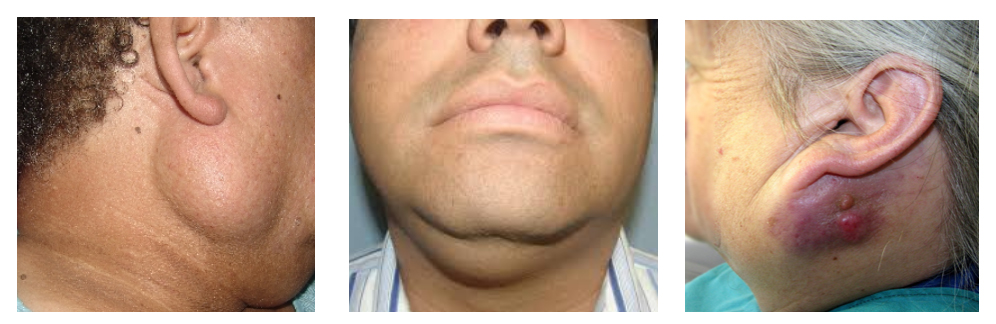
Parotid salivary gland: Located on the cheek, in front of the auricle and under the earlobe.
Submandibular salivary gland: Located in the lower back of the jawbone (mandible).
Sublingual salivary gland: Located at the back of the jawbone and the lower part of the tongue.
The salivary secretion they produce helps digestion and provides the necessary wetness and moisture for the mouth and other respiratory tract (throat, nose). it also creates a defense mechanism against microorganisms that lead to infection.
80% of salivary gland tumors are caused by the parotid salivary gland and often occur in the form of one-sided slow-growing masses. About 10% are caused by submandibuler salivary gland and the rest by sublingual and minor salivary glands. 80% of all tumors in salivary glands are benign and 20% are malignant tumors.
The most common benign tumor is pleomorphic adenoma and the second most common is Warthin tumor. The most common types of malignant tumors are mucoepidermoid cancer, adenoid cystic cancer and adenocancer.
What are the symptoms of salivary gland tumors?
Benign tumors occur as masses of the head and neck that are slow growing and do not spread to surrounding tissues and distant organs (no metastasis). Growth happens in months and years and they don’t cause pain. Malignant tumors grow faster, spread to surrounding tissues, regional lymph nodes and distant organs (lung, brain, etc.). They can also cause pain and facial paralysis. In cases where benign tumors remain in the body for many years, sometimes the transformation to malignant tumors can also be observed.
How is salivary gland tumors diagnosed?
The location of the mass in the patient’s neck, the time to be noticed, growth rate and additional complaints (such as pain, facial paralysis) should be questioned in the story. In the examination, the location of the mass, size, stiffness, facial nerve functions, skin condition on the tumor is evaluated. The nature of the mass, its relation to the deep structures, and its size can be evaluated by ultrasound, MRI and computed tomography as radiologically.
An ultrasound guided fine needle aspiration biopsy is performed from the mass for preliminary diagnosis and the samples taken are sent for histopathological examination. Although the pathological result obtained with this procedure is not a definite result, it still provides important information in guiding the physician who will continue the treatment. The diagnosis obtained during needle biopsy may vary after the pathological examination of the entire mass removed by surgery, and this final result shows the definitive diagnosis.
How is the treatment of salivary gland tumors?
The main treatment for these tumors is surgical removal of the tumor mass under general anesthesia. In benign tumors, there is no need for additional treatment after surgical removal of the tumor. In parotid benign tumors, usually the tumor is removed along with a portion of that gland (partial parotidectomy). In submandibular benign tumors, the entire salivary gland is removed.
In malignant tumors, the tumor needs to be removed with wider limits. Usually, the entire salivary gland has to be removed. If it is seen that the facial nerve is invaded with the tumor during surgery, the affected part of the facial nerve should be removed along with the salivary gland. In this case, nerve repair can be done with a piece of nerve taken from another place in the same session. In case of tumor spread to lymph nodes in the neck due to malignant tumors, the operation called “neck dissection”, in which lymph nodes in the neck are removed, should also be performed in the same session. In some types of cancer, radiotherapy and / or chemotherapy can be added to the treatment after surgery. In case of skin involvement, tissue transfer can be done to close surgery defect in front of ear using some reconstruction techniques.
Is there a risk of facial paralysis after surgery?
The most important risk for surgical treatment of parotid gland tumors is the deterioration of the functions of the facial nerve that runs through this salivary gland. In other words, it is the development of facial paralysis to varying degrees in the patient. If nerve integrity is not impaired during surgery, almost all of these facial paralysis are temporary and will recover within months (6-9 months at the latest). The probability of permanent facial paralysis is very low. If facial nerve function is impaired, it is more likely to be a partial facial paralysis, in which lower lip corner movements are affected (in this case the forehead and eyelids are less likely to be affected). The most important risk in submandibular salivary gland surgery is partial facial paralysis due to a dysfunction of facial nerve branches going to lower lip corner. As the tumor sizes and spread to surrounding tissues increase, the risks of surgery also increase.